Sam Altman and the day Nvidia’s meteoric rise came to an end
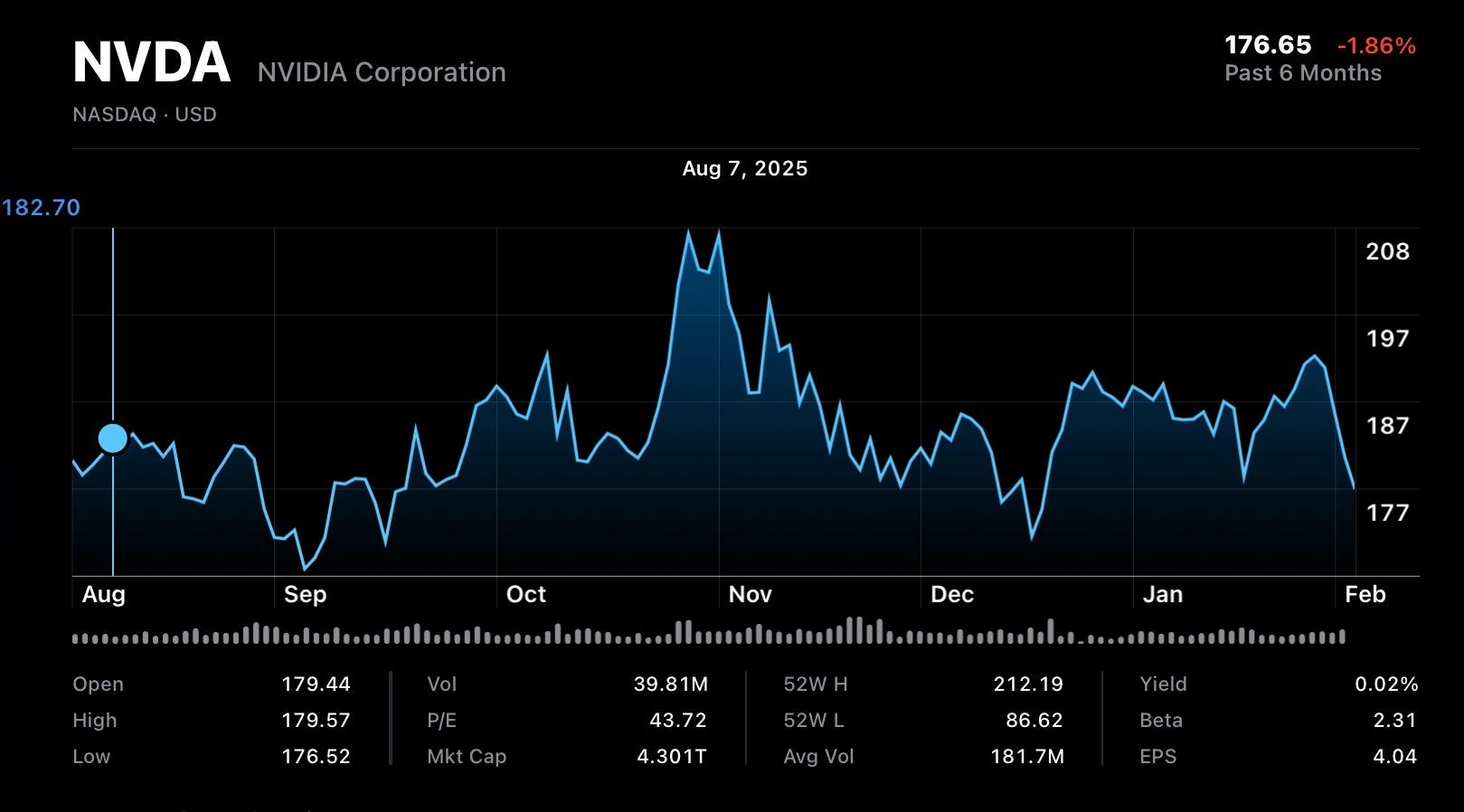
There is the NVidia of the last five years (up 1200%), and the Nvidia of the last six months (down 2%). When ChatGPT launched, it was trading at 14; it’s gone up by more than a factor of ten since then, rising, until recently like a rocket.
Aside from Nvidia’s Jensen Huang, a brilliant and impressive CEO with considerable foresight, nobody was more responsible for Nvidia’s rise than Sam Altman, the relentless showman who runs OpenAI — and who repeatedly promised the moon.
My favorite representative quote from Altman, just over a year ago, came in January 2025, back when too many people had too much faith him, writing in his blog “we are now confident we know how to build AGI.” It turns out this was authoritative bullshit. It sounded true and was said with confidence, but it was purely a bluff. Altman didn’t actually know how to build AGI [artificial general intelligence] then, and probably still doesn’t. Nvidia’s rise was predicated on the wrong-headed idea (long critiqued in this newsletter) that scaling would bring us to AGI.
As long as the scaling = AGI myth persisted, Nvidia, which makes the GPUs that fuel scaling, continued to rise like a rocket.
But all that changed on August 7th. That was the day that Altman introduced his wildly overhyped (for years) GPT-5 to the world, alleging, falsely, that it could do anything a PhD could do. By the end of the night, there was a rebellion in LLM land; people tried out the long awaited, much delayed model immediately, and just as quickly realized that what Altman said wasn’t true.
Questions that only a few of us (like Ed Zitron and myself) had been raising were suddenly on everyone’s lips. The industry seemed to increasingly rely on circular financing, so much so that an alternative NSFW framing of circular financing became a meme.
That circularity is a warning sign, reflecting a market that is propped up rather than functioning well on its own accord. Wall Street lost confidence, particularly after the crazy Oracle deal in September that I called at the time “peak bubble”.
On August 7, 2025, Nvidia was trading at about 181; today it stands at 177, stalled, a remarkable six month plateau for a stock that had risen more than 10x from 14 after ChatGPT was released in November 2022. Not an all out crash, but an unmistakable sign that its ascent has run out of gas. GPU-wrangler Coreweave stood then at about 129 and now stands at about 89. Oracle was at 250 and now (after its short lived OpenAI bump in September) stands at 150.
That fateful ChatGPT-5 introduction day last August — this Saturday will be the half anniversary — was the day people woke up to the reality that ChatGPT is not magic. LLMs are great, but they aren’t AGI, and they aren’t reliable. Moreover, they are expensive to operate, and because many companies can build roughly the same thing, they are commodities.
No moat = price wars.
No AGI = modest, not immense, profits.
As the investment press has been saying of late, investors have been “rotating out of tech stocks1” – because they realize they were sold a bill of goods. My guess is that these stocks – and the reputation of OpenAI – will fall further, but either way it is already clear that the rockets will not reach the altitude so many people were hoping for.
Not, at least, until newer, better, more robust approaches to AI are developed. For a few years, it seemed like the markets were swayed by hype, alternatives shut out. All that is starting to change. At last the market may be both ready—and desperate—for real AI.
The best news here is that with LLM mania subsiding, there might actually be a chance for newcomers to try new things.
People are likely rotating out of tech stocks for two almost contradictory reasons: some may be leaving companies like Nvidia out of concerns about circular financing and profitability of LLM companies, while others are leaving traditional companies like Salesforce because they’re worried about companies like Anthropic replacing traditional software. I am not sure that latter worry is realistic.